
Redefining the Conservation Landscape
The escalating global biodiversity crisis, driven by habitat destruction, climate change, and overexploitation, necessitates a radical re-evaluation of traditional conservation strategies. This has amplified the importance of ex situ approaches, leading to the evolution of concepts beyond the traditional botanical garden or seed bank.
Emerging as a sophisticated, multi-functional model is the Biological Resource Garden (BRG). More than just a collection of plants, the BRG is conceived as a dynamic, living library and research hub dedicated to the comprehensive documentation, conservation, and sustainable utilization of specific biological resources. Unlike traditional gardens that prioritize aesthetic display or general taxonomic representation, the BRG operates with a focused mission: to manage biodiversity as an invaluable resource base for future scientific, ecological, and economic needs. It represents a paradigm shift from passive preservation to active, resourceful management of genetic diversity.
I. Conceptual Framework and Core Philosophy
The BRG is built upon the foundational principle of resource-centric conservation. Its philosophy integrates ecology, ethnobotany, genetics, and biotechnology to ensure that conserved materials are not just preserved, but are readily available and scientifically characterized for use.
A. Distinction from Traditional Gardens
| Feature | Traditional Botanical Garden | Biological Resource Garden (BRG) |
| Primary Goal | Education, display, and general conservation of endangered species. | Comprehensive resource management, research, and sustainable utilization. |
| Focus | Taxonomic diversity (representing different plant families). | Functional diversity, genetic variability, and utility (medicinal, economic, ecological). |
| Documentation | Species name, origin, and general features. | Detailed genetic data, chemical profile (chemotype), ethnobotanical history, cultivation data. |
| Outputs | Public engagement and conservation data. | Bioactive compounds, germplasm for breeding, ecological restoration materials, intellectual property (IP). |

B. The Triple Mandate
The BRG operates under a triple mandate that defines its operational scope:
- Conservation and Documentation: Maintaining the maximum possible intraspecific (within-species) genetic variability, focusing on economically or ecologically important genepools. This goes beyond species-level identification to detailed Accession-level management.
- Characterization and Research: Systematically analyzing the conserved resources for key traits, including chemical profiles (phytochemical screening), pest and disease resistance, nutritional value, and genetic markers. This process transforms raw biological material into scientifically valuable resources.
- Sustainable Utilization and Benefit Sharing: Providing authenticated, high-quality material for research, breeding programs, and ethical, sustainable commercial development, adhering strictly to principles of Access and Benefit Sharing (ABS) protocols derived from the Nagoya Protocol.
II. Operational Components of a BRG
A fully functional BRG is a highly integrated system comprising several specialized units that work in concert:
A. The Living Collection (The Garden Itself)
The garden section is the visible, ex situ component where living specimens are maintained.
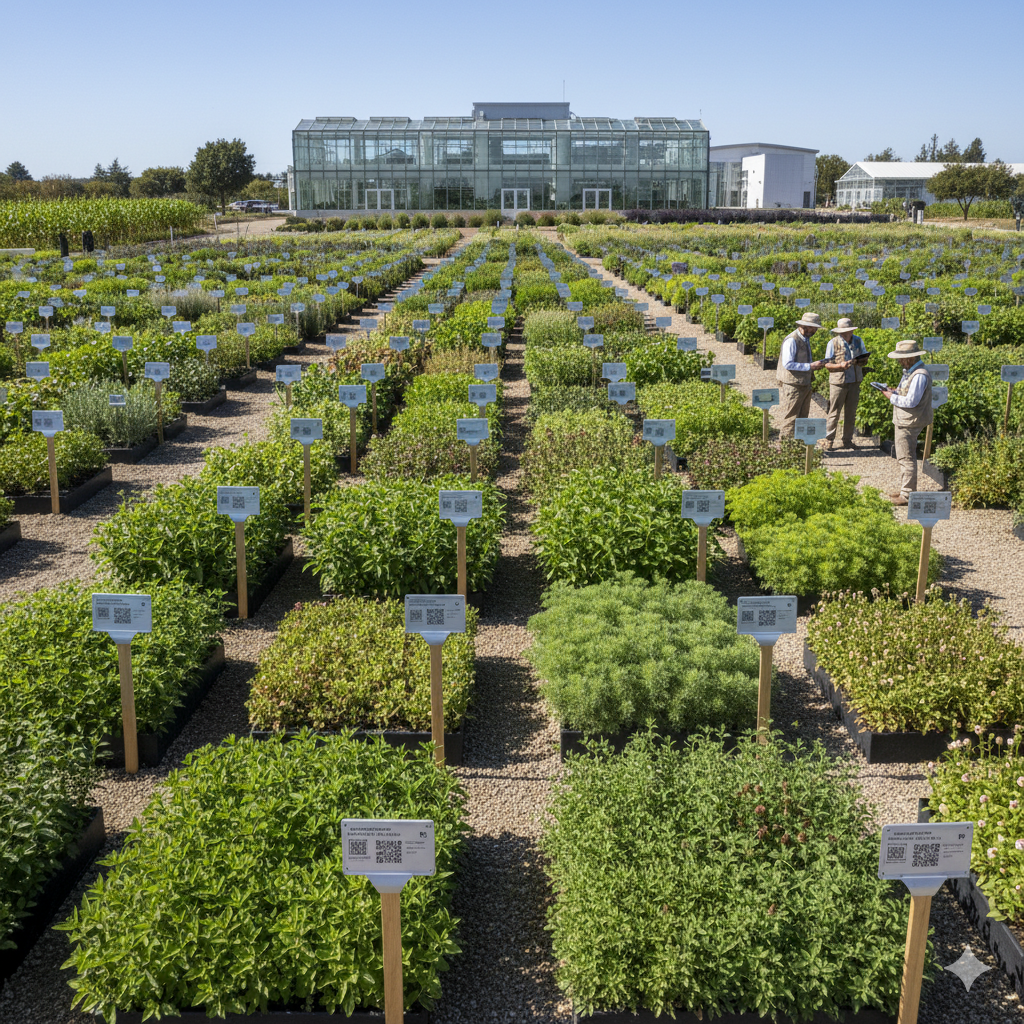
- Intraspecific Diversity Blocks: Instead of planting a single example of a species, a BRG will plant multiple accessions (individual samples collected from different wild populations) to capture the full spectrum of genetic variation. This is crucial for traits like resistance to a new disease or variation in secondary metabolite production.
- Habitat Mimicry: Cultivation practices are tailored to mimic the plant’s natural ecological conditions as closely as possible to minimize genetic drift and stress, ensuring the specimens retain their original characteristics (chemotypes).
- Authenticity and Vouchering: Every plant must be vouchered—a preserved specimen stored in an institutional herbarium—and linked to its precise geographic collection data (geo-coordinates) to confirm its identity and origin.
B. The Data Management and Informatics Unit
This is the intellectual backbone of the BRG, distinguishing it from a simple garden.
- Database Integration: A robust, relational database is essential to link every accession number to a wealth of associated data: collection site, collector, habitat description, soil analysis, cultivation records, genetic markers (DNA fingerprints), and results from all chemical screenings.
- Chemotype Mapping: For medicinal plants, this unit tracks and maps the variation in key chemical compounds across different accessions. For example, two plants of the same species might produce different concentrations of a valuable alkaloid; the BRG tracks and manages these distinct chemotypes.
- Public Access Portal: To fulfill its mandate of utilization, the BRG must maintain a searchable, publicly accessible database (while protecting sensitive locality data for vulnerable species).
C. The Ex Situ Ancillary Units (The Backup System)
The BRG employs backup systems to safeguard genetic material against catastrophic loss in the living collection.
- Seed Banks (Gene Banks): Dry, low-temperature storage of seeds is the primary backup for orthodox (storable) species.
- Field Gene Banks (or Satellite Gardens): Duplicates of valuable accessions are often maintained in a separate geographical location to safeguard against localized disasters.
- In Vitro/Cryopreservation Unit: For recalcitrant (non-storable) seeds or clonally propagated species, tissues or apical meristems are preserved under liquid nitrogen (cryopreservation), offering the longest-term, safest storage of genetic diversity.
III. Applications and Strategic Value of the BRG
The strategic value of a Biological Resource Garden extends far beyond simple conservation, impacting public health, agriculture, and environmental stability.
A. Pharmaceutical and Nutraceutical Development
- Authenticated Starting Material: Research and commercial entities require authenticated, ethically sourced, and chemically standardized plant material to ensure reproducibility and efficacy. The BRG provides material with verified taxonomy, documented origin, and quantified chemotype.
- Screening for Bioactives: The BRG acts as a pre-screened pool of genetic resources. Researchers can query the database for plants known to produce high yields of a desired compound or those displaying resistance to certain pathogens, drastically accelerating the drug discovery pipeline. For instance, screening different accessions of an Artemisia species to find the highest-yielding strain of artemisinin.
B. Agricultural Resilience and Breeding
- Climate Change Adaptation: As climate variability increases, breeders need access to genetic material with traits for drought tolerance, heat resistance, or salt tolerance. A BRG focused on food security (e.g., wild relatives of cereals or legumes) provides this critical, diverse germplasm.
- Pest and Disease Resistance: Wild relatives often possess resistance genes that have been bred out of modern crops. The BRG maintains these resistant accessions, making them available for introgression into commercial breeding lines, enhancing food system resilience.
C. Ecological Restoration and Climate Mitigation
- Locally Adapted Stock: Successful ecological restoration requires plant material adapted to the specific local environment. BRGs maintain accessions collected from discrete eco-regions, ensuring that restoration projects use the most genetically appropriate and locally adapted stock for reforestation or habitat repair.
- Carbon Sequestration Research: BRGs can focus on conserving and studying species with exceptionally high rates of carbon uptake or superior growth rates in marginalized lands, providing solutions for climate mitigation strategies.
IV. Ethical, Legal, and Socio-Economic Implications
The operation of a BRG is inextricably linked to complex global frameworks governing biodiversity access and ownership.
A. Access and Benefit Sharing (ABS)
Adherence to the Nagoya Protocol is non-negotiable for a BRG. The garden must meticulously track the origin of every accession. Any commercial benefit derived from the material (e.g., a patented compound or a successful crop variety) must be shared fairly and equitably with the country and, critically, the Indigenous and Local Communities (ILCs) from which the material was originally sourced. The BRG acts as the fiduciary steward, ensuring that utilization leads to sustainable development in the source communities.
B. Intellectual Property (IP) and Material Transfer Agreements (MTAs)
To prevent biopiracy and ensure materials are used ethically, the BRG issues materials only under strict Material Transfer Agreements (MTAs). These legally binding contracts define what the recipient can do with the material, how the BRG must be credited, and the terms for benefit-sharing if the research leads to commercialization. The BRG must also protect itself from misappropriation while promoting open science.
C. Community Engagement and Traditional Knowledge
A critical aspect of the BRG model is the respectful and proactive engagement with Indigenous and Local Communities (ILCs). Much of the functional information (ethnobotanical data) that defines an accession’s value comes from Traditional Knowledge (TK). The BRG must incorporate mechanisms for Prior Informed Consent (PIC) and Mutually Agreed Terms (MAT) before documenting or utilizing TK, recognizing its role as a key informational resource.
V. Challenges and Future Directions
Establishing and maintaining a BRG presents significant technical and financial challenges.
A. Resource Mobilization
The high cost of comprehensive genetic and chemical characterization, combined with the continuous operation of cryo-banks and advanced databases, requires substantial and sustained funding. Reliance on short-term grants is unsustainable; BRGs need to establish public-private partnerships and explore novel funding mechanisms, potentially through micro-licensing access to their pre-screened data.
B. Technical Expertise
Running a BRG demands highly specialized interdisciplinary teams, including molecular geneticists, phytochemical analysts, database managers, ethnobotanists, and conservation horticulturists. Recruiting and retaining this talent in a single location is a constant challenge.

C. Scaling and Network Integration
The future effectiveness of the BRG model lies in its ability to be scaled up and integrated into a global network. Individual BRGs must specialize (e.g., a BRG dedicated to high-altitude medicinal herbs, or one focused solely on cocoa wild relatives) and share data and germplasm across standardized protocols. This network approach ensures maximum coverage of global genetic diversity and minimizes redundancy in research efforts.
Conclusion
. By rigorously integrating conservation with advanced scientific characterization and ethical governance, the BRG transforms dormant biological potential into an accessible, actionable resource for innovation. It serves as a vital bridge between the natural world and human needs, positioning itself as an indispensable institution for securing ecological resilience, driving biotechnological discovery, and ensuring fair and equitable benefit-sharing in an era defined by genetic information. The BRG model offers a powerful template for managing the planet’s irreplaceable biological wealth for generations to come.
Here are four images to accompany the article, illustrating key aspects of a Biological Resource Garden: